Santa Patrizia: The Other Neapolitan Liquefaction
Working out what to book?The lane itself is free and never sold out — you can walk it at eight in the morning with nobody in it. What does sell out is the Cappella Sansevero slot next door, and what you cannot buy at the door is somebody who can tell you why the street is there at all. Both come bundled into the walking tours below, cancellable free up to 24 hours ahead.
See what the tours costWhat is actually in the church
Her relics were brought here in 1864 and are in the fifth chapel on the right. The statue dates from 1625. Her silver reliquary bust is among those kept in the Cappella del Tesoro beside the Duomo, which is why her name turns up in two places in the same city. Her feast day is 25 August, and a liquefaction was reported on 25 August 2026. Locally the church is often called the Chiesa di Santa Patrizia rather than San Gregorio Armeno, and what else is behind that door is on the church and cloister.
Why this is not the same as San Gennaro
The two get run together constantly, and they should not be. Here is the difference as plainly as I can put it.
- San Gennaro is the principal patron of the city. Santa Patrizia is one of roughly fifty-two co-patrons.
- San Gennaro has three fixed dates in the calendar and the first documented liquefaction is 1389. Santa Patrizia’s is tied to a feast day and a devotional weekday, not to a fixed civic calendar.
- San Gennaro’s ampoules are in a chapel administered by a lay body, the Deputazione del Tesoro, open to anyone, free. Santa Patrizia’s relics are inside an active convent that also runs a school and publishes no opening hours of its own.
- The record for Santa Patrizia is explicitly irregular. It states that the liquefaction occurs in different ways and at different times over the years.
So: same city, same phenomenon by name, very different footing. San Gennaro is a public event the whole city watches and has watched for six centuries. This is a devotion inside a convent. The San Gennaro side is on the patron saint of Naples.
Do not plan a Tuesday around it
I want to be blunt, because I have seen visitors disappointed by a promise this site will not make. The Tuesday liquefaction is not guaranteed. There is a Mass at 09:30 and there is exposition of the blood. What happens after that is not on a timetable and no page, including this one, can tell you in advance. Go for the Mass, the church and the cloister, and treat anything further as a thing that may or may not happen while you are standing there.
The other reason to think twice about a Tuesday: the Museo Cappella Sansevero is closed on Tuesdays, so a Tuesday costs you the Veiled Christ. The trade-off is set out on when to go.
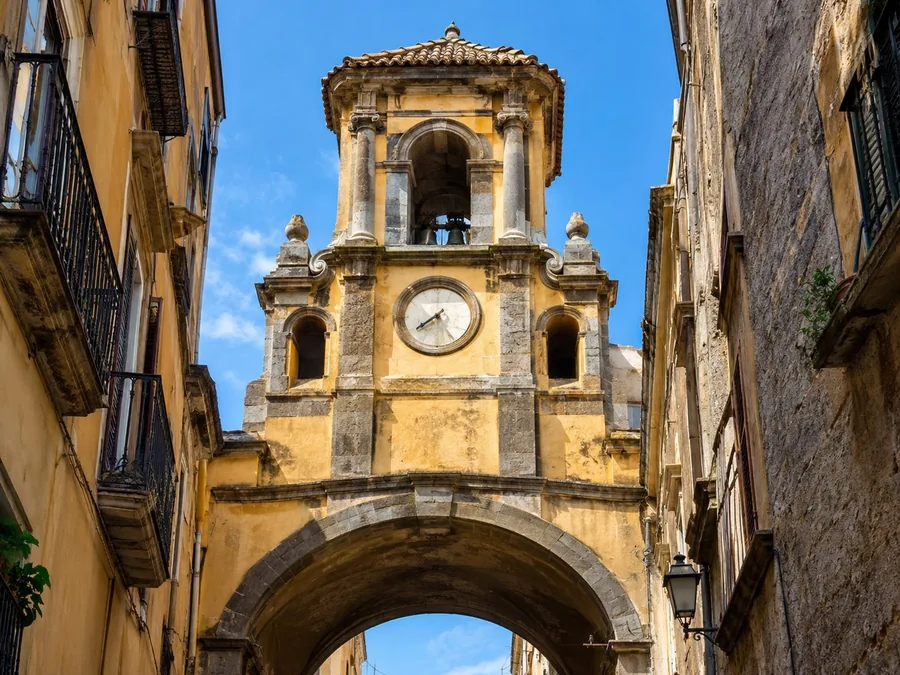
None of the six tours on this site goes into this church, including the one above. That walk is €48, three hours, guided in Italian only, and it ends with skip-the-line entry to the Cappella Sansevero. It passes the bell-tower arch and stays outside the door, like all the others.
If you are in the church on a Tuesday morning, stay for the Mass rather than looking for the reliquary and leaving. It is a working community at prayer and that is the actual thing in front of you.
Frequently asked questions
Does the blood of Santa Patrizia liquefy every Tuesday?
It is not guaranteed. Tuesday is her devotional day, with a 09:30 Mass and exposition of the blood, and the record itself says the liquefaction happens in different ways and at different times over the years. Nobody can promise it in advance.
Is Santa Patrizia the patron saint of Naples?
No. She is one of roughly 52 co-patrons. The principal patron is San Gennaro — see the patron saint of Naples.
Where are the relics of Santa Patrizia?
In the church of San Gregorio Armeno, at number 1 on the lane, in the fifth chapel on the right. They were moved there in 1864 and the statue dates from 1625. Opening hours are disputed — see the church and cloister.
When is the feast of Santa Patrizia?
25 August. A liquefaction was reported on 25 August 2026.