Inside the Church and Cloister of San Gregorio Armeno
Working out what to book?The lane itself is free and never sold out — you can walk it at eight in the morning with nobody in it. What does sell out is the Cappella Sansevero slot next door, and what you cannot buy at the door is somebody who can tell you why the street is there at all. Both come bundled into the walking tours below, cancellable free up to 24 hours ahead.
See what the tours costThe door most people walk past
The bell tower of San Gregorio Armeno is thrown across the lane as an arch, joining the two halves of the convent over the heads of the shoppers. It is the single most photographed object on the street. Almost nobody who photographs it then turns left and pushes the door at number 1, which is a few steps away and leads into the church. I have stood under that arch on a December afternoon and watched several hundred people pass it in an hour without one of them going in.
The complex sits at 40.8496° N, 14.2575° E, on the western side of the lane, closer to the Via dei Tribunali end than to Spaccanapoli. Locally the church is often called the Chiesa di Santa Patrizia rather than San Gregorio Armeno, after the saint whose relics are in it, which is worth knowing if you are asking directions from somebody who lives here. The anatomy of the lane from top to bottom is laid out on getting there.
Sixty-two scenes by Luca Giordano
Giordano painted 62 fresco scenes in this church, and they are counted among his major works. That number is the reason the church matters to art historians, and it is the reason I would rather you went in here than into three better-signposted churches elsewhere in the centre. Above them runs a coffered gilded wooden ceiling carrying paintings by Teodoro d’Errico, a Fleming who worked in Naples. The nuns’ choir, the gallery the enclosed community used so that it could hear Mass without being seen, was frescoed around 1632 with the lives of St Gregory and St Benedict.
None of this is behind glass and none of it is explained on a panel. You get what you brought with you. That is the argument for reading something first, and it is also the argument that runs through whether any of this is worth paying for.
The cloister and the fountain
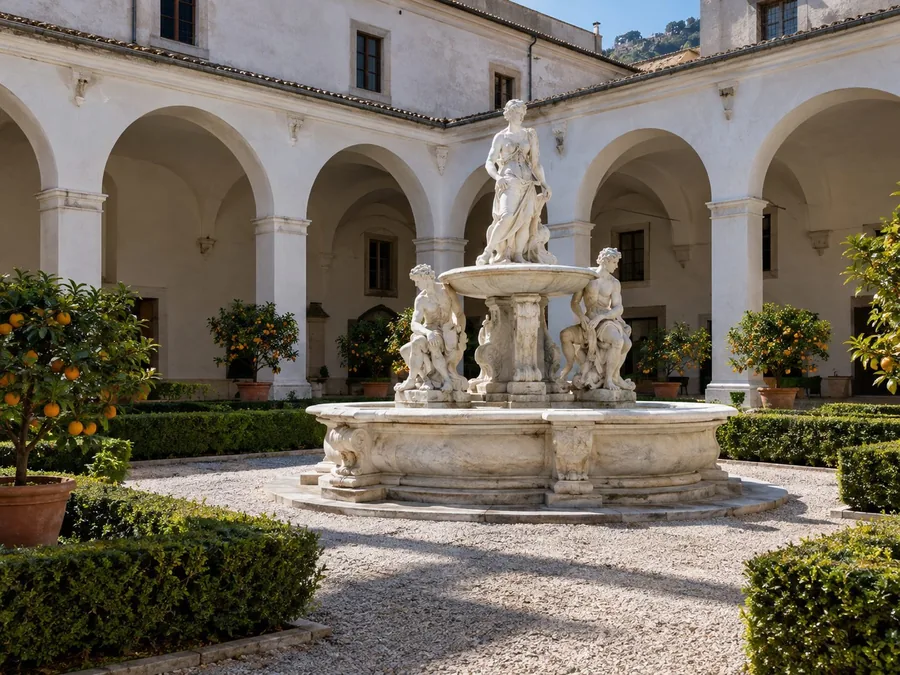
The cloister is the part I send people for. It holds a 16th-century marble fountain with a life-size group of Christ and the Samaritan Woman, attributed to Matteo Bottiglieri. Two figures, at your own height, in a walled garden, forty steps from a street where you cannot put your elbows out. The contrast is the whole point of the visit and I am not going to be subtle about it: the street is the loudest place in the historic centre and the cloister is one of the quietest, and they share a wall.
Santa Patrizia is in the fifth chapel on the right
Her relics were moved here in 1864 and her statue dates from 1625. She is one of roughly 52 co-patrons of Naples and not the principal one, which is San Gennaro. Her blood is said to liquefy, and her devotional day is Tuesday, with a Mass at 09:30. It is not a guaranteed weekly event and I explain why at length on the other Neapolitan liquefaction.
The opening hours, and the three versions of them
Here is the honest state of it. No opening-hours publication by the community itself exists that I could find, and the three most-quoted secondary sources do not agree with each other.
- Daily 10:00–13:00 and 15:00–18:00, with Saturday and Sunday afternoons running to 19:00. This comes from a guide checked on 10 September 2026 and it is the version I publish as the working answer.
- Monday to Friday 09:00–12:00, Saturday and Sunday 09:00–13:00. No afternoon opening at all.
- 09:30–13:00 daily, plus Saturday and Sunday 15:00–18:00. This is what the directory listings carry.
All three overlap at one point only: late morning, any day of the week. If you have a single shot at this door, take it between about 10:30 and midday, and telephone +39 081 552 0186 first. That is a tedious instruction and it is the correct one.
The ticket, and the caveat that comes with it
The same source that gives the fullest hours gives the price as about €4, free under 5 and over 65, and says the ticket covers the church, the cloister, the Cappella dell’Idria, the refectory, the ancient oven, the nuns’ choir and the abbess’s parlour. It also warns, in its own words, that the community does not publish that figure itself. So carry a small note and do not be surprised by a different number, or by an offering box instead of a ticket desk. Separately, third-party operators sell guided visits of the complex at roughly €10 to €14 per person. That is their rate, not the monastery’s, and the two are constantly confused online.
How a church from Armenia ended up on this lane
In the 8th century nuns fleeing Byzantine iconoclasm reached Naples carrying relics of St Gregory the Illuminator, the apostle of Armenia. A church existed here by about 930, and in 1009 four oratories were unified into a single Benedictine monastery. What you walk into now is the late 16th-century rebuilding: designed by Giovanni Francesco Mormando and executed by Giovanni Vincenzo Della Monica and Giovan Battista Cavagna. Sources put the start of the work somewhere between 1572 and 1574 and do not agree; the majolica dome was finished in 1577, the church was consecrated in 1579 and the job was done by 1580.
According to tradition the site was a temple of Ceres, where citizens left small terracotta votive figures made in workshops nearby. I want to be exact about that word: tradition. No excavation report confirms it. It is still the most repeated sentence about this street, and I take it apart on the Neapolitan presepe.
It stopped being Benedictine in 1922
On 4 December 1922 the Benedictines were replaced by the Suore Crocifisse Adoratrici dell’Eucaristia, who hold the complex today and run a school attached to it. This is not a museum with a chaplain. It is a religious community and a working school, and the door at number 1 is their front door. Cover your shoulders, keep your voice down in the cloister, and accept a closed door without an argument: there will be a reason for it and it is not owed to you.
No tour on this site goes in
I have checked all six. Every one of them walks past the arch and several of them stop under it. None of them enters the church or the cloister. If a listing says “San Gregorio Armeno”, it means the lane. This is the single most useful thing I can tell somebody who has typed the name into a search box, and it is why I would not book a tour in order to see the inside of this building. Book a tour for the decumani around it, for the Cappella Sansevero slot that is genuinely hard to get, and for somebody to tell you what you are looking at — then walk back on your own and push the door.
The tour above is the flagship on this site and it is guided in Italian only, which is the first thing to know about it and the thing its own listing buries. It costs €48 and includes skip-the-line entry to the Cappella Sansevero. The alternatives, in English and otherwise, are compared on the historic-centre walking tours.
Go in the late morning, before you walk the lane rather than after. The cloister is a much better room when your ears are still working. The full anatomy of the street is in the complete guide.
Frequently asked questions
What are the opening hours of the church of San Gregorio Armeno?
The working answer is daily 10:00 to 13:00 and 15:00 to 18:00, with Saturday and Sunday afternoons to 19:00. Two other widely quoted sources give morning-only hours instead, and the community publishes nothing itself. Telephone +39 081 552 0186 before you travel.
How much does it cost to go into the cloister?
About €4, free under 5 and over 65, covering the church, cloister, Cappella dell’Idria, refectory, ancient oven, nuns’ choir and abbess’s parlour. That figure is not published by the community itself, so treat it as an indication. Third-party guided visits of the complex sell separately at about €10 to €14.
Do any tours go inside the church and cloister?
None of the six on this site. They all walk the lane and stop under the bell-tower arch, and they all stay outside the door. What a guide is actually worth is argued out on whether it is worth it.
Is San Gregorio Armeno still a monastery?
Yes, but not a Benedictine one. The Suore Crocifisse Adoratrici dell’Eucaristia replaced the Benedictines on 4 December 1922 and still hold the complex, with a school attached. Dress and behave as you would in any working convent.
Who painted the frescoes in San Gregorio Armeno?
Luca Giordano painted 62 fresco scenes here, among his major works. The coffered gilded wooden ceiling carries paintings by the Fleming Teodoro d’Errico, and the nuns’ choir was frescoed around 1632 with the lives of St Gregory and St Benedict.